

Eight billion people, each running a handful of AI-powered agents: one that shops, one that manages money, one that books travel, and so on. Assume ten agents per person and you can see the entry of 80 billion new digital sprites into our Internet in our near future.
That’s not even counting the larger fleets of agents running within companies. Companies are already operating armies of coding agents, procurement agents, sales and customer service agents, and so on. Within a decade, persistent agents with budgets will inevitably outnumber humankind in our digital economy.
But whether the end state is ten useful agents per person or one chief of staff or a hundred micro-agents isn’t the point. What’s most important is that each agent represents a new potential customer. Agents become customers when they have identity and memory, hold authority over a budget, possess the ability to choose and transact, and have accountability to a human or corporate owner.
80 billion agents would represent tens of billions of new decision-making and transaction endpoints acting on existing human and corporate capital. A logistics agent might purchase ten minutes of real-time supply chain monitoring. A research agent might pay for one database query. A coding agent might rent a specialized security agent for thirty seconds. These economic flows can occur at a higher velocity than any system with humans in the loop, driven by transactions of machine-to-machine services too small and fleeting for any human to buy manually, and designed for financial rails that operate at the speed of software – in other words: blockchains.
Which raises the key question: who will own these 80 billion agents? The people and businesses they represent? Or the platforms they run on? Depending on the answer, what role can blockchains play in this battle for the next 80 billion customers?
The Sovereign AI Movement
AI sovereignty is the ability of a person or institution to operate, govern, and improve its intelligence, independently of a platform or provider’s changes in technology, pricing, policies, availability, etc. Today, three layers of society are converging on the need for sovereign AI:
The first is national sovereign AI. Nation-states want domestic compute, culturally and linguistically appropriate models, strategic capacity, and jurisdictional control. They don’t want critical government, defense, healthcare, and industrial systems to depend on a foreign provider that can change its prices, policies, or availability at any time. They certainly don’t want their nation’s economic destiny to be in someone else’s hands in a post-AI world.
The second is enterprise sovereign AI. Companies increasingly recognize that their evaluations, corrections, workflows, and agent traces form a proprietary learning loop. Major AI providers generally claim that enterprise data isn’t used to train their models by default. But who captures the product insight, workflow knowledge, usage signals, and improvement loop created as employees and customers use AI? As Microsoft’s CEO, Satya Nadella, wrote recently: “In consuming intelligence, you are creating intelligence. What you create should belong to you.” Or, as former Coinbase CTO, Balaji Srinivasan, stated previously: “Not your weights, not your model.”
The third is personal sovereign AI. Individuals will eventually want AI-powered assistants with private memory, user-controlled permissions, local or confidential execution, and the ability to move between providers without losing years of accumulated context. A downloadable transcript is not enough. Users need the memory, preferences, skills, and relationships that make the agent theirs. Not your memory, not your agent.
The most forward-thinking companies are already putting AI sovereignty into practice. Leading fintech company Ramp, a self-declared “AI-native company,” built an internal AI suite and custom coding agents with 99% adoption across their 1,000+ employees. For enterprises, the most valuable asset may be the learning loop rather than the model.
The message is clear: To own your destiny, you must own your intelligence.
Agents Are Economic Actors
Gartner projects that agentic customers will influence or participate in $30 trillion of purchases by 2030. And right on schedule, the necessary primitives for activating 80 billion customers are starting to show up.
Take payments as one example. The world’s largest payment networks are rebuilding their infrastructure for a customer that barely existed two years ago. Visa’s Intelligent Commerce and Mastercard’s Agent Pay can issue tokenized payment credentials to agents and enforce user-selected spending limits and conditions. Coinbase’s x402 lets software pay for API calls and online resources with stablecoins, making sub-$0.01 payments commercially practical.
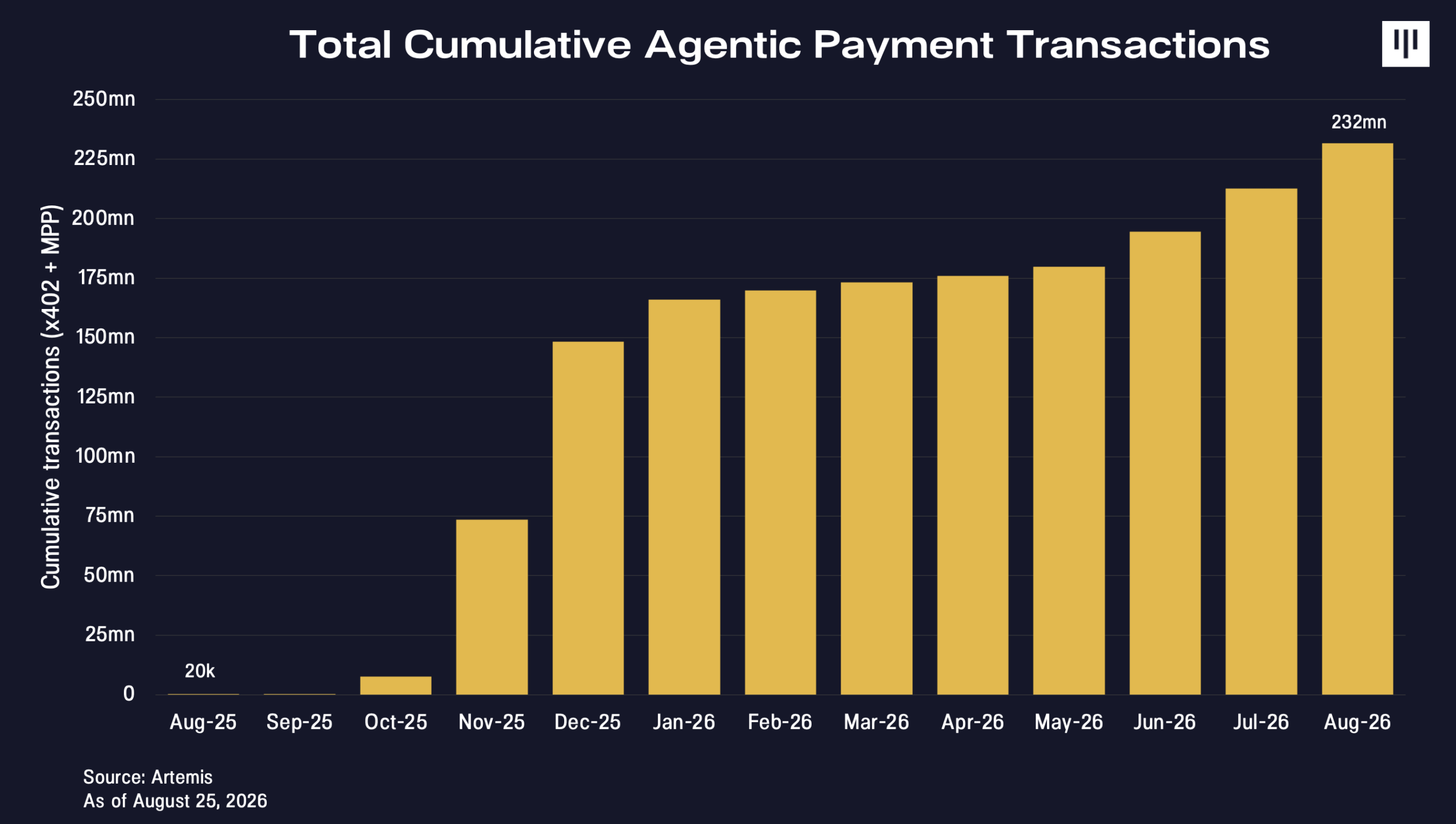
Today an agent can buy a database query. Tomorrow, it may manage a cloud budget, negotiate a vendor contract, or reallocate a portfolio. The progression of AI’s role from recommendation to transaction to capital allocation is likely to be faster than expected. Cloudflare’s CEO recently shared that automated systems accounted for over 57% of HTTP requests to web content worldwide, as agentic activity surpasses human traffic on the Internet. When agents can hold authorization credentials, select their counterparties, and settle transactions, they will represent a new economic force, albeit with new challenges.
If a platform controls your agents’ identities, memories, evaluations, and learned behavior, switching providers means firing your entire digital workforce and replacing it with amnesiacs. Every price increase or policy revision from today’s dominant AI platforms would become a hostage negotiation.
Every prior platform war was fought to own the customer relationship. This one will be fought to own the customer’s AI-powered representative, a potentially more powerful position because agents sit upstream of every purchasing decision: which products get considered, how they are ranked, what information is disclosed, which payment rail is used, and what price the customer sees.
A platform-owned agent could prefer suppliers that pay the platform, hide competing products, steer users toward affiliated financial services, and use private context to estimate willingness to pay. It could make switching intentionally difficult, learn from the user’s transaction history, and collect a toll on every agent-facilitated purchase.
Soon, the big question may not be whether your agent is capable, but whether your agent is loyal.
The Agent Economy Needs Property Rights
In a world of conflicting loyalties and existential platform risk, it’s clear that the agent economy needs property rights. They need verifiable, bounded authority from the people and institutions they represent.
As agents gain more capabilities and generate more value, their dispatchers will likely demand more rights: control over the agent’s identity, memory, authority, capital, and learning. A person should be able to say: “This agent may spend up to $2,000 per month on travel, book refundable economy flights, disclose my passport only to verified airlines, and never transact with sanctioned entities.”
That mandate has to be machine-readable, narrowly scoped, time-limited, auditable, revocable, portable between runtimes, and enforceable independently of the model. Therefore, we will need the instantiation of property rights independent of a foundational model or platform, which define who is entitled to issue orders to a particular agent.
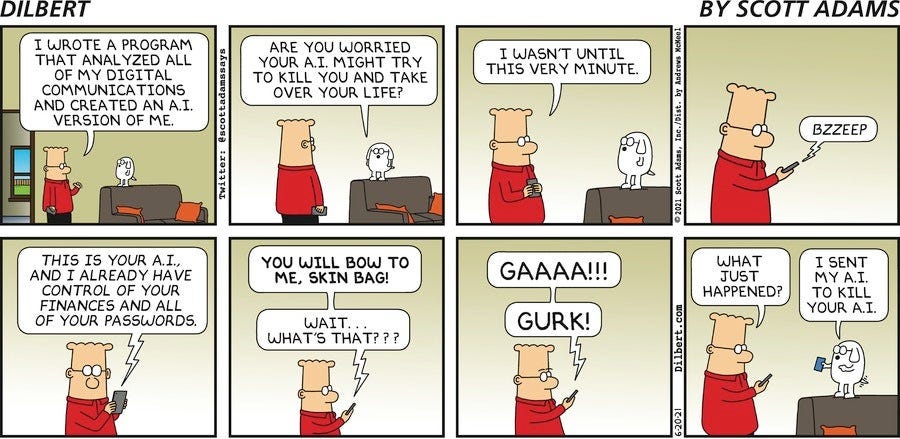
This is why digital wallets may become more important to agents than browsers were to humans. Each agent will require a wallet holding its digital-native identity, user approvals, working capital, and instructions. But today’s wallets are dangerously incomplete for the task. A private key can answer a binary question: can this actor sign or not? But agents need allowances, approved counterparties, time limits, transaction simulation, automatic revocation, and human escalation. An agent should not receive permanent access to a treasury any more than an intern should receive the company’s bank password.
Source: Scott Adams, Dilbert, June 20, 2021
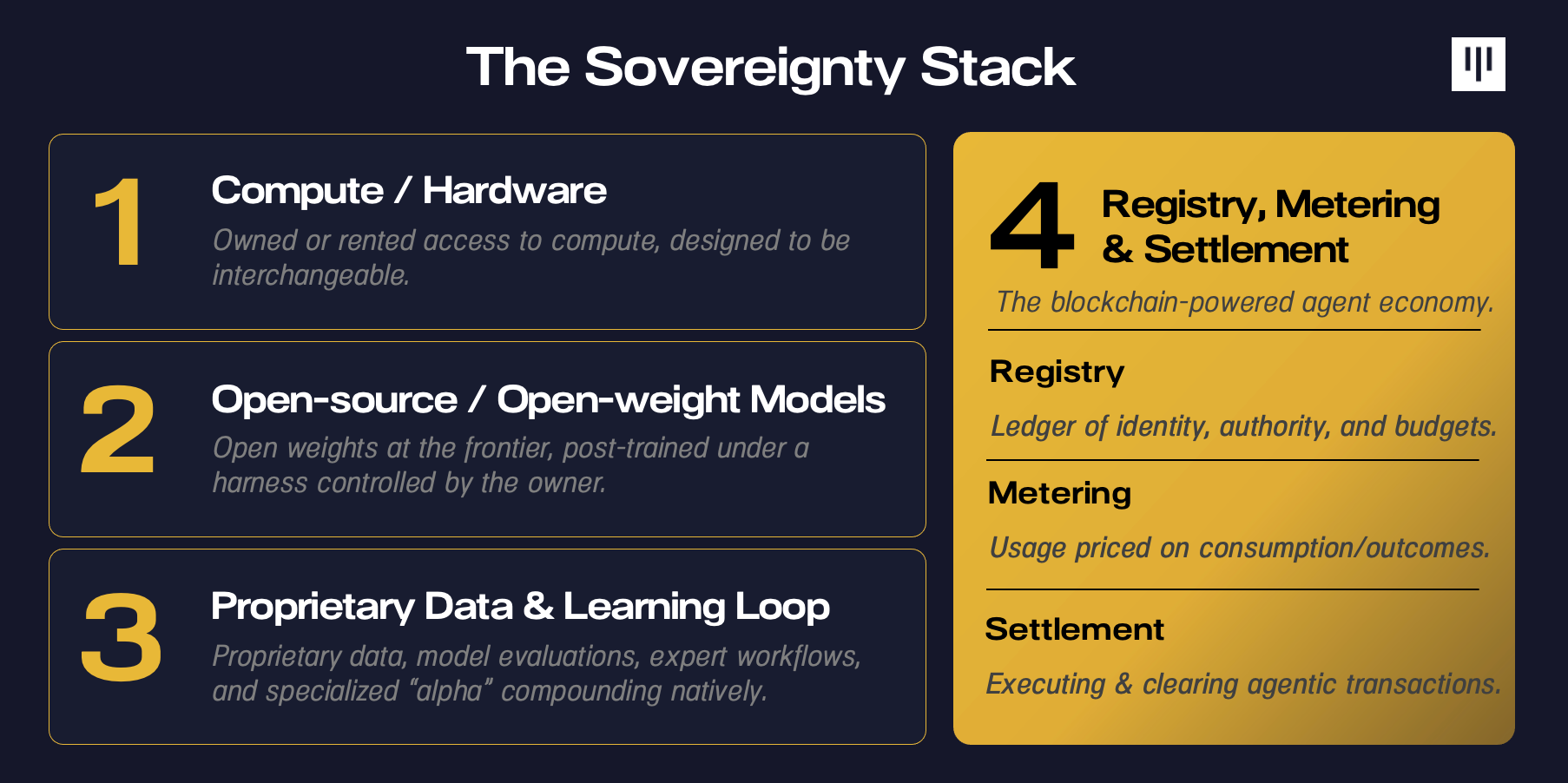
Property rights require more than a public record of ownership. They require a durable way to establish who controls an asset, delegate limited authority over it, enforce the limits of that delegation, and transfer control without another platform’s permission. Blockchains are natural infrastructure for agent property rights because they offer a persistent, programmable, public ledger that isn’t owned by any platform or model provider.
This architecture also makes rights portable. Swap the model or host, and the agent’s identity, capital, permissions, and transaction history stay with the owner. No platform can unilaterally rewrite the ownership record or trap the agent’s assets. Blockchains help anchor ownership, delegation, and settlement in a neutral system shared across platforms. That grants agents their most important feature of AI sovereignty: the ability to pick up and go elsewhere, without losing their most valued possessions.
A New Commercial Surface
Agents will also change how companies design products and reach 80 billion new customers.
Today’s internet businesses are built for humans: landing pages, pop-up ads, search rankings, and loyalty programs. Agent customers will prioritize machine-readable inventory, transparent prices, reliable APIs, verifiable claims, settlement speed, refund rules, service guarantees, and compatibility with the agent’s mandate. Agents don’t care about your company’s logo or charming sales representatives. Whatever gets the job done.
This creates a second commercial surface, in addition to the human-centric Internet:
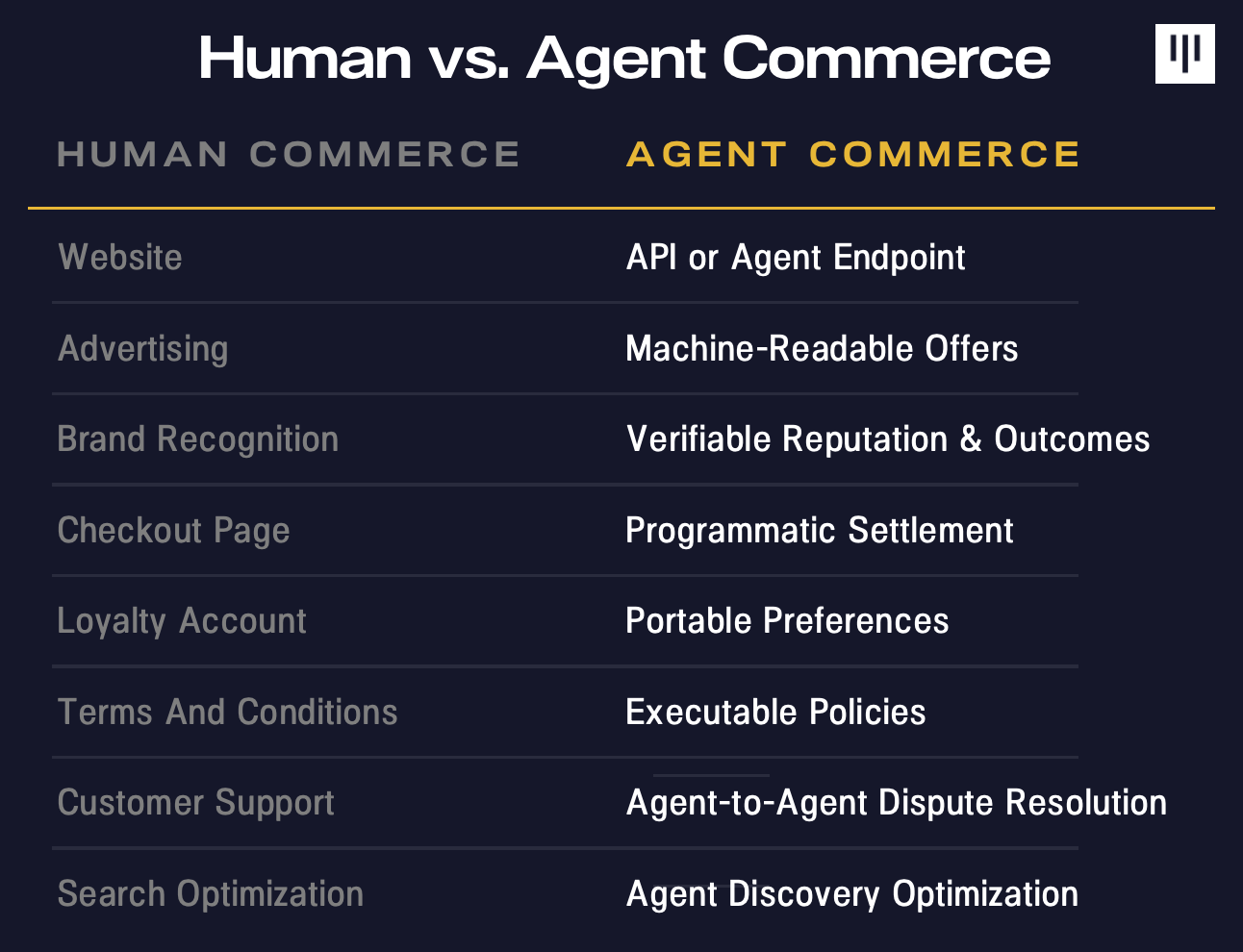
Humans will still encode preferences for quality, status, privacy, convenience, and familiarity; the mechanics of influence will change. A favorable ranking may depend less on keyword optimization than on price, fulfillment history, data policies, and provable credentials.
Every business will eventually need to answer the question: Can an authorized agent discover, evaluate, purchase, and use our product without a human in the loop?
The Convergence of Sovereign AI and Blockchain
In a world where 80 billion agents come online and each one represents a sovereign economic actor, it’s clear that a global peer-to-peer settlement layer is critical to this agent economy. Blockchains are the appropriate tool to create digital property rights for this new wave of digital natives.
As intelligence itself becomes a digital asset, agents will need machine-readable ways to express who controls it, who can use it, and how its value is exchanged. We believe expression will most naturally occur on a blockchain.
As investors looking towards this convergence of AI sovereignty and blockchain technology, here is a running list of ideas and business models that excite us today:
Intelligence-asset infrastructure: Models, datasets, memories, skills, and evaluations are digitally native productive assets. New infrastructure is needed to make their ownership, provenance, access, and revenue rights machine-readable and programmable.
Agent control planes: Think of these as “sovereign agent operating systems.” This is the interface through which a person or company creates and supervises agents across frontier APIs, open models, private clouds, and local devices. They coordinate models, memory, policies, credentials, budgets, and execution without permanently owning the customer’s assets or learning loop.
Open agent-discovery marketplaces: If billions of agents offer services, other agents need ways to find and evaluate them. Blockchains can coordinate independent suppliers of data, models, compute, and agent services within an open marketplace, denying control to any single platform. They can also serve as the verifiable, immutable system of record for agents’ track records, outcome-based rankings, or specialized credentials.
Agent security: Empowering agents with money and authority comes with new security challenges. In particular, enforcing the boundary between the probabilistic reasoning of LLM’s and the deterministic action of onchain transactions.
Agent wallets, delegation, and credentials. Programmable wallets and session keys give agents narrow, revocable authority rather than unrestricted access to private keys. Verifiable credentials allow an agent to prove whom it represents and what it’s allowed to do.
Portable reputation: Agents will need histories of successful transactions, disputes, reliability and specialization. A neutral reputation system, instantiated on a blockchain, protects agents from having to start from zero.
Sovereignty-as-a-service: Companies will need tools to deploy across private and public compute, switch models, route sensitive workloads, and preserve continuity when a provider changes. Rent-to-own access to compute from platforms like B3IQ (Pantera portfolio company) can help organizations move towards AI sovereignty. By owning compute, they can own their destiny.
What We Need to Believe
Much like decentralization, sovereignty is not a sufficient value proposition by itself. Most customers will not pay a large premium for portability during normal conditions. The best products will turn sovereignty into everyday economic value: lower cost, better performance, tighter privacy, faster customization, or greater reliability. In other words: Product advantages derived from sovereignty.
In order for 80 billion agents to thrive in a world of sovereign AI, several things must become true:
Agents must receive meaningful authority rather than remain sidekicks to their human users.
Agent memory and learning loops must become valuable enough that customers demand portability.
Security systems must make delegated spending acceptable.
Merchants must expose products and services to agentic buyers.
Open rails must offer a real advantage over platform-controlled identity and payments.
The momentum is already visible. What began as software for answering questions is quickly becoming software for allocating capital and executing transactions.
The first phase of AI was about opening up access to intelligence. The next phase will be about deciding the ownership of intelligence. As Palantir CEO, Alex Karp, recently said: “We cannot have a society where all the value goes to 2,500 people sitting in Silicon Valley. That just will not work, and no one’s going to put up with it.”
When economic power proliferates across 80 billion agents, the key battle will become whether agents compound intelligence and value for the platforms that host them or for the people and institutions they are supposed to serve. AI sovereignty ensures that the value created by an agent compounds for you, rather than for your vendor. Blockchains provide the property rights for intelligence and the neutral settlement layer that makes those rights programmable, portable, and enforceable across platforms.
As investors, we’re excited to invest at the convergence of AI sovereignty and blockchain, where we believe the future of the agent economy and its 80 billion customers will be built.
“We had better be quite sure that the purpose put into the machine is the purpose which we really desire.”
– Norbert Wiener, founder of the science of cybernetics, the study of control and communication in animals and machines (1960)